EU AI Act Labels Are Now Mandatory: What You Risk Without One, and How to Add It in a Minute
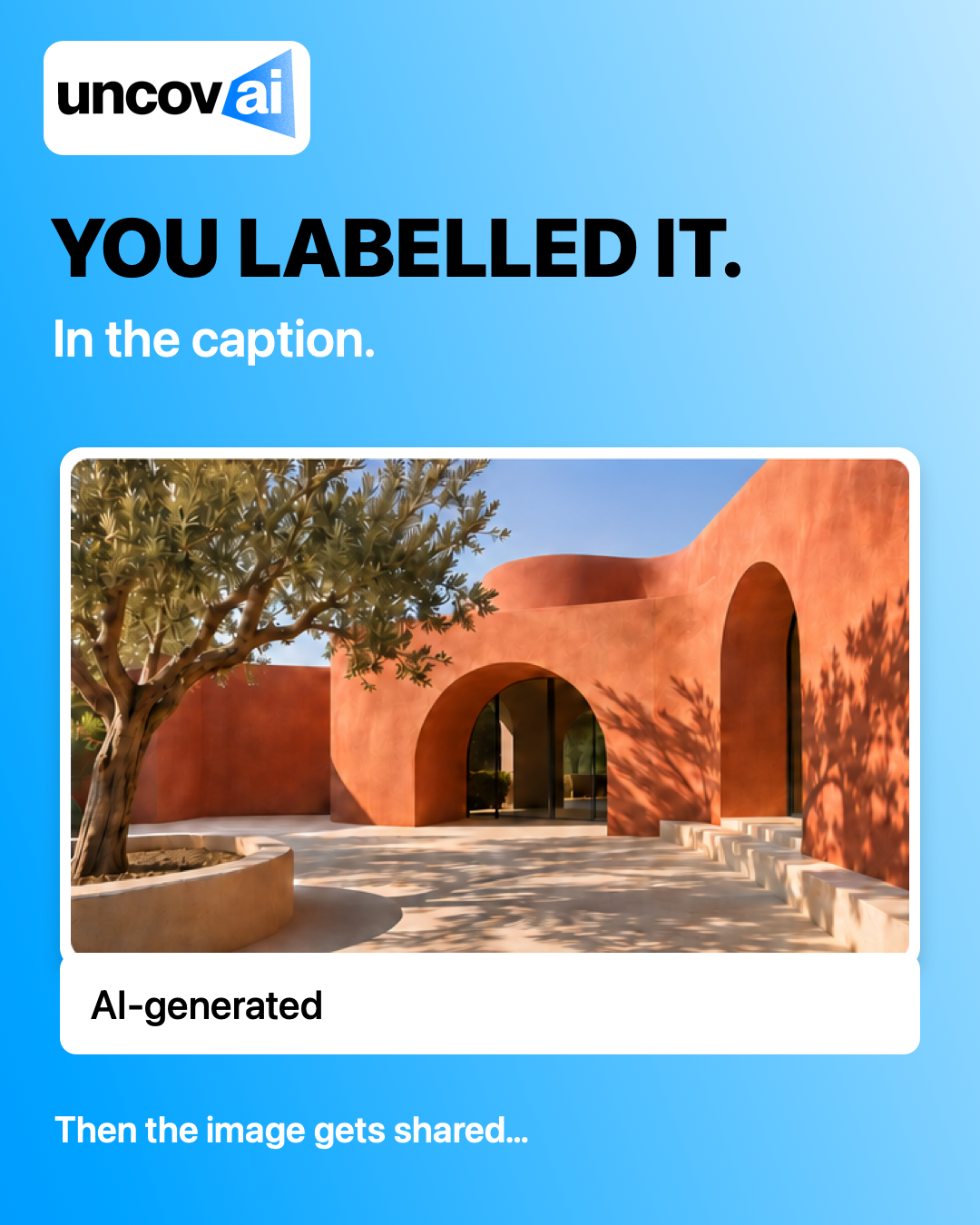
Since 2 August 2026, Article 50(4) of the EU AI Act requires anyone who publishes a deepfake to disclose that AI generated or manipulated it. Fines can reach €15 million or 3% of worldwide annual turnover, whichever is higher (for small and medium businesses, whichever is lower). You can add the official EU icon to your images and videos with the UncovAI AI Act label tool.
Picture an ordinary Monday

Marta runs a small online shop in Lyon. Six months ago she started creating ad visuals with AI: a “model” wearing her dress on a Paris riverbank, polished like a magazine cover. It was cheap, fast, and nobody noticed. (This is an illustrative example, not a real case.)
That is exactly why Marta should pay attention now. The rule isn’t written for the companies that build AI models. It’s written for the people who publish the content: shops, creators, agencies and social media managers. That includes Marta, and possibly you.
What is mandatory, and since when
Article 50(4) of the EU AI Act requires deployers of AI systems that generate or manipulate image, audio or video content constituting a deepfake to disclose that the content has been artificially generated or manipulated. The rules have applied since 2 August 2026 (Article 113).
Under Article 3(60), a deepfake is AI-generated or AI-altered content that resembles real people, objects, places or events and could pass for authentic. A photorealistic AI “person” in your ad, a generated location that doesn’t exist, or a swapped face in a real video all fit.
What happens if you don’t label
| Situation | Maximum fine |
|---|---|
| Large company | Up to €15M or 3% of worldwide annual turnover, whichever is higher |
| Small or medium business | Up to €15M or 3% of turnover, whichever is lower (Article 99) |
These are ceilings, not automatic amounts. Actual penalties are set by national authorities in each EU country. The real risk is simple: you are publishing deepfake content with no disclosure.
Does your content need a label?
Not all AI content falls under the rule, so it helps to sort it:
- Realistic images and videos that could pass for real: a label is required, visible from first sight.
- Evidently artistic, satirical, creative or fictional works: disclosure is still required, but in an appropriate way that doesn’t hamper the display or enjoyment of the work.
- Uses authorised by law to detect, prevent, investigate or prosecute crime: no label required.
- AI text published to inform the public on matters of public interest: labelled unless a person reviewed it and holds editorial responsibility. Our tool handles images and videos only.
Not sure whether a file was made by AI? Check it first with the UncovAI detectors.
Which EU icon should you use?
The European Commission published three icons that are free to use, with no attribution needed. Using them is optional. Disclosing is not.

AI (basic icon)
AI was involved in creating the content. Also the right choice when you add your own text label beside the icon.
AI-generated
AI made all of it, and a person only wrote the prompt.
AI-modified
AI changed part of real, human-made content, such as a swapped face or an empty apartment furnished with AI.
Where to place the label: the Commission’s four rules
- Visible at first sight. People should see it the moment they see the content, not at the end.
- Clear of overlays. On vertical video for TikTok, Reels or Shorts, buttons and captions cover the right side and the bottom, so place the icon at the top.
- Embedded in the picture. A label burned into the pixels stays when the file is downloaded or reshared.
- Big enough to read. Choose a clearly visible size, and add alt text saying the content is AI-generated when you post.
How to label your files in a minute

- Drop your files. Images and videos, up to 50 at once. You see the cost before anything starts.
- Choose and place the icon. Pick one of the three official EU icons in white or black. Drag it onto the picture, tap where you want it, or use the arrow keys. Adjust size and opacity for each file.
- Download. Each file comes back with the icon burned in, in the same format and quality. Images take seconds, long videos a few minutes.
Pricing: 1 credit per file, with 2 free files a day without an account. Files are deleted after 24 hours.
Label my content →Frequently asked questions
Is it mandatory to label AI-generated content in the EU?
Yes, for deepfakes: realistic AI images, video and audio that could pass for real. The obligation has applied since 2 August 2026.
What is the fine for not labelling AI content?
Up to €15 million or 3% of worldwide annual turnover. For small and medium businesses, the lower of the two applies.
Who has to add the label, the creator or the publisher?
The obligation falls on the deployer, meaning whoever uses the AI system and publishes the content, not only on the model’s developer.
Do I have to use the European Commission’s icons?
No. The icons are optional. The disclosure itself is mandatory, and the icons are a recognisable way to make it.
Does adding the icon make me compliant with the AI Act?
Not by itself. The Commission states that using the icons does not establish legal compliance, and deployers remain responsible for ensuring their disclosure meets Article 50.
Do artistic or satirical works need a label?
Yes, but in a lighter form that doesn’t get in the way of the work.
Important note
This article is for information only and is not legal advice. An icon helps you meet the disclosure duty but does not guarantee compliance. If you’re unsure how the rules apply to your business, consult a legal professional.
Sources: Regulation (EU) 2024/1689 (the AI Act), Articles 3, 50, 99 and 113; European Commission, “EU Icons for labelling AI-generated content.”