
An AI Video Detector for Fact-Checkers: A VoxCheck Case Study
VoxCheck, the fact-checking team behind VoxUkraine, spent 2026 debunking a run of AI-generated videos aimed at Ukraine's military. Different fakes, different narratives — the same tool in the verdict each time: UncovAI.
A fake TTsK officer with a warning for draft dodgers
In May 2026, a clip started moving through Ukrainian social media. A man in a TTsK (territorial recruitment center) uniform tells the camera that after the war, everyone will face one question: what did you do during it. He says he'll have an answer — he served. Draft dodgers won't.
It's a narrative built to spread on its own. It doesn't argue against a policy. It attacks a person's excuse for staying home, using someone else's face to do it.

VoxCheck ran the clip through UncovAI's video detection tool and got a verdict on both channels at once: the footage was AI-generated, and so was the voice.

The manual tells backed it up. Sharpness that didn't match the blur around the man's face. Body movement that read as jerky rather than fluid. Flickering across the fabric of his uniform once the footage was zoomed in — a common artifact in synthetic video once you know where to look for it.
Full fact-check: voxukraine.org
A staged clip mocking a soldier with Down syndrome
Two months later, a different clip surfaced on pro-Russian Telegram channels. It showed a Ukrainian serviceman apparently mocking a fellow soldier who has Down syndrome. The post framed it as proof of cruelty inside the army during wartime mobilization.
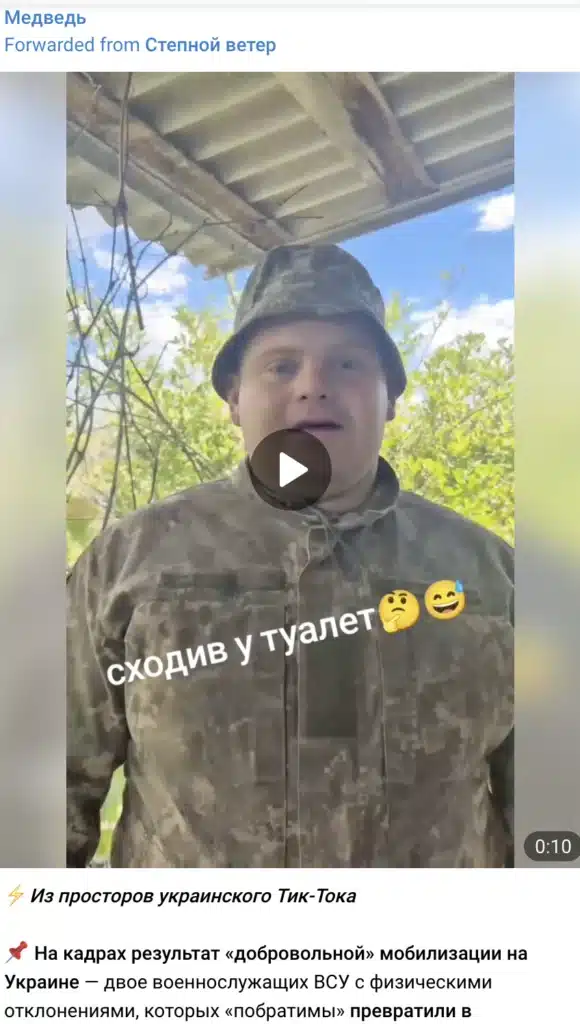
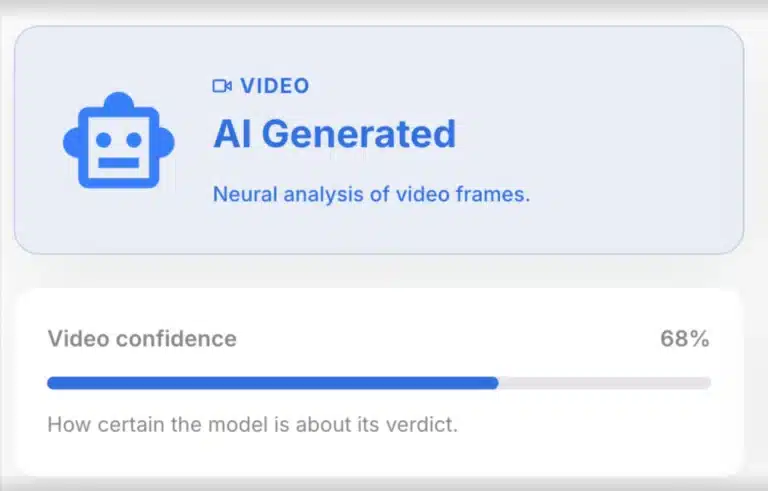
VoxCheck's check came back at 68% confidence: AI-generated. That's the kind of number you can put in an article and defend, rather than an analyst's judgment call that a reader either trusts or doesn't.
The visual tells matched what shows up in identity-based deepfakes generally: a faint "mask" edge around the face, a gaze that didn't track naturally, expressions that stayed a beat too stiff. VoxCheck traced the clip back to a channel that had run the same playbook before — content built around Ukrainian soldiers with disabilities, each time synthetic. For teams tracking this kind of impersonation at scale, that's exactly the pattern an AI scam and deepfake detector is meant to catch early.
Full fact-check: voxukraine.org
A marketplace for fake target footage that doesn't exist
The third case had less to do with faces and more to do with fraud. A post claimed Ukrainian soldiers were buying fake "target hit" clips from a site called StrikeVidMarket, then submitting them to earn extra points in a real military equipment program. The story came from a Telegram account impersonating a well-known brigade — one VoxCheck had already caught faking news before.
Two checks killed the story. First, no trace of "StrikeVidMarket" existed anywhere — not on the open web, not in archive snapshots. Second, running the clip's audio through UncovAI confirmed the voice was synthetic, not a real recording.
Full fact-check: voxukraine.org
Take a real anxiety — cowardice, cruelty, corruption — and attach it to a synthetic clip. The emotion is what makes people share it before anyone checks if it's real.
What this means for verification teams
Three fakes, three different narratives, one recurring step in the fact-check: a detection tool result the newsroom could screenshot and publish alongside the debunk. That's a different kind of evidence than "our team believes this is fake." It's checkable by the reader, and it holds up when the original poster pushes back.
It also covers more ground than any single manual check. Across these three cases, VoxCheck used UncovAI on video alone, on an isolated audio track, and on video and audio together in one pass. Teams built for this kind of work — see our use cases for newsrooms and fact-checkers — tend to need exactly that range, because disinformation doesn't stay in one format for long.
Speed matters as much as range. A narrative like this spreads fastest in its first few hours online. A detection check that returns a result in seconds, instead of a frame-by-frame review that takes a day, is what keeps a debunk useful instead of late.
Frequently asked questions
What tool did VoxCheck use to detect the fake TTsK officer video?
VoxCheck ran the clip through UncovAI's video detection tool, which found that both the video footage and the audio track were AI-generated.
How confident was UncovAI in the Down syndrome deepfake case?
UncovAI returned a 68% confidence score that the video was AI-generated, which VoxCheck published alongside a screenshot of the result.
Can UncovAI detect AI-generated audio as well as video?
Yes. UncovAI checks video and audio separately or together in the same clip, which is how VoxCheck confirmed a synthetic voice in the fake drone-bonus story.
Is VoxCheck an independent fact-checking organization?
Yes. VoxCheck is the fact-checking project of VoxUkraine, a signatory of the International Fact-Checking Network's Code of Principles. Its wartime fact-checks are published in partnership with Meta.
Testing detection against your own case backlog
If your newsroom or fact-checking desk is dealing with the same kind of synthetic media, we can walk you through what UncovAI catches and how it fits into a verification workflow.
Talk to Our Team →